
A Tiny SNP, a Tasty Flip: How a Single Mutation Regulates Quinoa’s Seed Saponin Content [11.03.26]
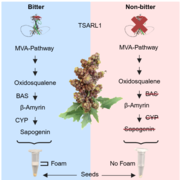
Quinoa (Chenopodium quinoa Willd.) is valued for its nutritional benefits and resilience to abiotic stress. However, its commercial use is limited by bitter-tasting saponins on the seeds, necessitating resource-intensive removal processes.
We demonstrate a SNP in the transcription factor TSARL1 as significantly associated with the non-bitter phenotype. Furthermore, our findings confirm the SNP’s critical function in downregulating the saponin biosynthesis pathway. Additionally, protein modelling validates TSARL1s presumed responsibility for the bitter phenotype. Finally, we introduce an efficient method to detect the SNP, streamlining breeding of non-bitter quinoa varieties. Our approach offers significant implications for the agricultural production and nutritional exploitation of quinoa, aligning with efforts to meet global food security and nutritional needs.
